
By Riley Dauber ’25
Major: English; Minors: Journalism, Editing, & Publishing, Gender Studies, and Communications & Media Studies
Contributor Biography: Riley is a junior majoring in English with a triple minor in Journalism, Editing, and Publishing; Communication and Media Studies; and Gender Studies. Outside of the classroom, she is the Lifestyle Editor for The Elm, the Social Media Coordinator for Writers’ Union, the President of Film Club, and a Peer Writing Consultant at the Writing Center. In her free time, she loves reading silly romance books (she is currently on a billionaire and hockey romance kick, but not at the same time), watching movies, and spending time with her friends.
Brief Description: For Dr. Knight’s Book History class, we were assigned a research paper that focused on one aspect of the communications circuit. As an avid romance reader, I wanted to focus on a topic related to the genre. After narrowing my ideas, I chose to look at contemporary romance novels and their illustrated, cartoon covers. If you were to walk into a bookstore and see these covers, you would not know that the book contains mature themes and sexual content because the cover is so misleading. However, this style has recently gained popularity thanks to social media apps like TikTok. The main aspect of my paper was close-reading Emily Henry and Tessa Bailey’s book covers to determine why this style is so popular.
The following was written for ENG 460: Book History
Introduction
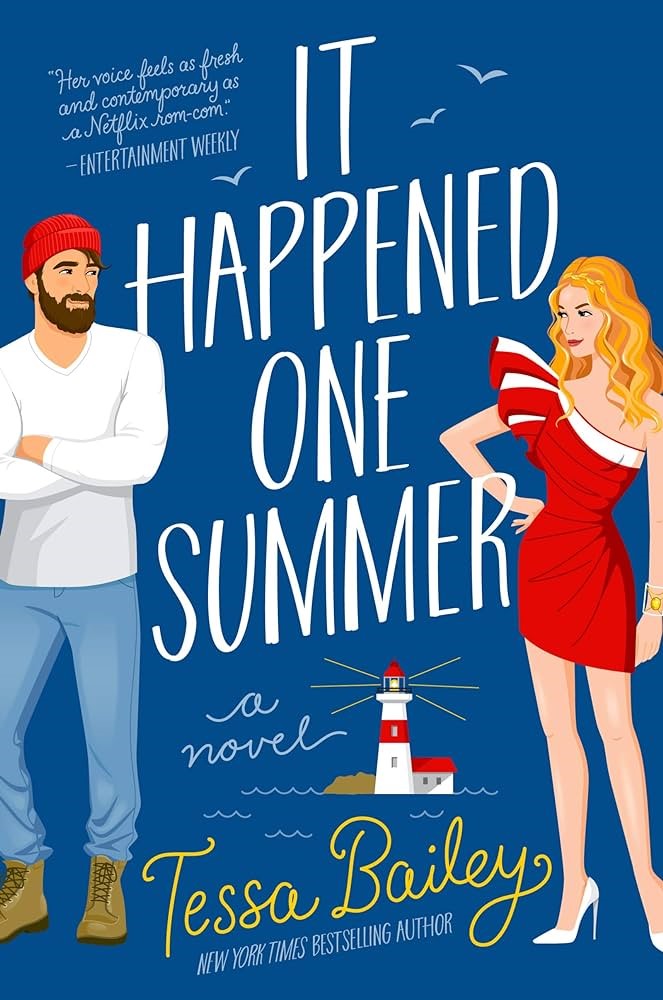
While I have always been an avid reader, I was not exposed to the romance genre until I read Tessa Bailey’s novel It Happened One Summer. I received it for Christmas a few years ago after noticing it at my local Barnes and Noble. The cover immediately caught my eye thanks to the navy blue coloring and cartoon illustrations. I read the book over winter break in 2021, and I would bring it along with me while I babysat. Because of the cover’s art style, lack of real people, and character positioning, the child’s family members were unaware of the adult romance novel I was reading.
Since reading Bailey’s book, romance has become my favorite and most-read genre. According to Storygraph, a website I use to track my reading goals, I have read thirty-one romance books this year. Needless to say, I am a huge fan, and I am always looking for recommendations on social media, since apps like TikTok have helped the genre grow in popularity. The video sharing platform features many different sub-communities, including BookTok, where content creators post videos recommending books. Once a book is featured, users are encouraged to read it for themselves, leading specific books, regardless of release year, to gain popularity (Schwartz and Sullivan). According to Dimitriee Curcic, the romance genre has always been popular, but thanks to social media, it is becoming more popular with younger readers. He writes, “Romance readers are getting younger. 10 years ago, the main romance-reading group was women ages 35 to 54. Today, the main romance-reading group is women ages 18 to 54” (Curcic). Curcic also stated that “romance sales grew by 52%” from 2021 to 2022, showing social media’s influence on the genre.
The romance genre consists of a few different subgenres, including contemporary, historical, and dark romance. The former is the main focus of this paper, as contemporary romance books feature a plethora of brightly-colored, illustrated, cartoon covers. In their 2012 article about romance book covers, Maryanne L. Fisher and Tami M. Meredith conclude that covers featuring real people are growing in popularity (162). Eleven years later, if one were to walk into a Barnes and Noble and peruse the romance section, they would see a multitude of illustrated, cartoon covers, proving that covers featuring real people are no longer popular. The illustrated covers are always a bright shade of an eye-catching color and feature a pair of characters that hint at the book’s romantic plot. As Schwartz and Sullivan write in their article, “Marketing trends, like covering contemporary romance novel jackets with cartoon figures and bright colors, has also helped pull in a younger audience,” (“Gen Z is driving sales of romance books to the top of bestseller lists”). As the genre shifted toward illustrated, cartoon covers, younger readers picked up the books and reviewed them on social media, which in turn led to the current popularity of the genre.
Research Question
This paper is looking at why illustrated, cartoon covers are popular within the contemporary romance genre. Based on the aforementioned statistics, it is clear that these types of covers are introducing younger readers to the genre, but this paper wants to focus on why this cover style is more popular than the traditional cover design, which would feature real people or simple photos and text.
While romance was always the main focus of this paper, the genre raises many different questions that caused the topic to evolve throughout the research process. Initially, I was inspired by an activity we did on the first day of class where we close-read Harlequin romance covers. This activity led to my first idea about the evolution of the romance genre as a whole, and how the changing covers reflect this evolution. However, I soon realized that this topic was too broad and needed to be narrowed down for this specific assignment. By narrowing my topic, I had to forgo my possible interests in how romance authors market their books, as well as the genre’s diversity, both in terms of the authors and the characters. I was struggling to narrow my topic, so I went back to my original idea about the covers and the evolution of the romance genre and decided to specifically focus on illustrated, cartoon covers in contemporary romance novels. This decision led to the following research question: Why are illustrated, cartoon covers more popular than traditional covers in the contemporary romance genre?
Methodology
When it came to locating my primary sources, I decided to focus on two popular authors in the contemporary romance genre: Emily Henry and Tessa Bailey. According to Curcic, Henry was the second most popular romance author in 2023. He writes, “Another major figure in the romance world…is Emily Henry, responsible for 32% of all romance novel sales in print formats as of 2023” (Curcic). Henry currently has four books: Beach Read, People We Meet on Vacation, Book Lovers, and Happy Place. According to Temple, both Book Lovers and People We Meet on Vacation were among the bestselling books of 2022 (“These are the bestselling books of 2022”).
Not only is Henry a popular author within the contemporary romance genre, but she also switched from publishing her books in paperback to hardback. Her most recent book, Happy Place, was released in hardback on April 25, 2023, contrary to her first three books that were published in paperback. I was curious as to how readers reacted to this switch, because if they own the first three books in paperback, a hardback book would not match if they were displaying the four books together. I turned to Henry’s Instagram account, specifically her posts announcing Happy Place. I also utilized her website and emailed her cover designer, Sandra Chiu, for more information on her cover design process and the switch from paperback to hardback.
Bailey is another popular contemporary romance author, and I selected her four most recent titles: It Happened One Summer;, Hook, Line, and Sinker;, Secretly Yours;, and Unfortunately Yours. While her covers also feature illustrated, cartoon designs, all four titles are published in paperback. The first two titles and last two titles are duologies following different characters in the same world, so I was curious as to how the covers advertised this element. I utilized Bailey’s website and emailed her cover designer, Monika Roe, for more insight on the designs.
For my secondary sources, I wanted to find information about the romance genre and why these illustrated, cartoon covers are so popular. “The Romance Publishing Industry and Its Reputation” by Lauren Cameron discusses the genre as a whole and how many readers turn to it as an escape from their regular lives. She writes, “Many respondents said that discovering romance was a source of happiness” (Cameron 9). Readers are able to disappear into a fictional world and imagine themselves as the main characters. This article raised questions about the covers’ involvement in both the escapist quality and the public’s negative assumptions about the genre. This secondary source pairs nicely with Shana McDavis-Conway’s article, “Self-conscious, unapologetic, and straight: fat protagonists in romantic fiction,” and Fisher and Meredith’s, “The Success behind the Candy-Colored Covers: An Evolutionary Perspective on Romance Novels.” While the former discusses a topic that is not relevant to my project – specifically, plus-size representation in the romance genre – the article also mentions the genre’s escapist quality and how added diversity allows readers to relate to the main characters (McDavis-Conway 234). The latter article mentions how readers are able to identify with the characters because of the cover details (Fisher and Meredith 155). This information directly connects to my primary sources, as well as theanalysis of the eight romance covers and their escapist quality, which will help me determine why this type of cover design is so popular.
Along with my primary sources and journal articles, I utilized other online information to discuss the popularity of the genre. The New York Times Best Sellers List, specifically the webpage “About the Best Sellers,” provided insight into how the publication determines the list’s entries. Since Henry and Bailey’s books were on the Best Sellers list upon release, this information shows how popular the two authors and their books are with readers. Other statistics – including Curcic’s information on romance novel sales, Schwartz and Sullivan’s NPR article about social media and its influence on the publishing industry, and Temple’s list of “the bestselling books of 2022” – provided details on why the romance genre is currently popular with younger readers and which specific books were recently popular.
While the main focus of this paper is the eight illustrated, cartoon covers and how they relate to the design’s popularity, the aforementioned secondary sources and statistics provide information on the romance genre as a whole. Some also mention the current trend of illustrated, cartoon covers; sources directly discussing social media’s influence on the genre proved to be helpful during the research process.
Findings
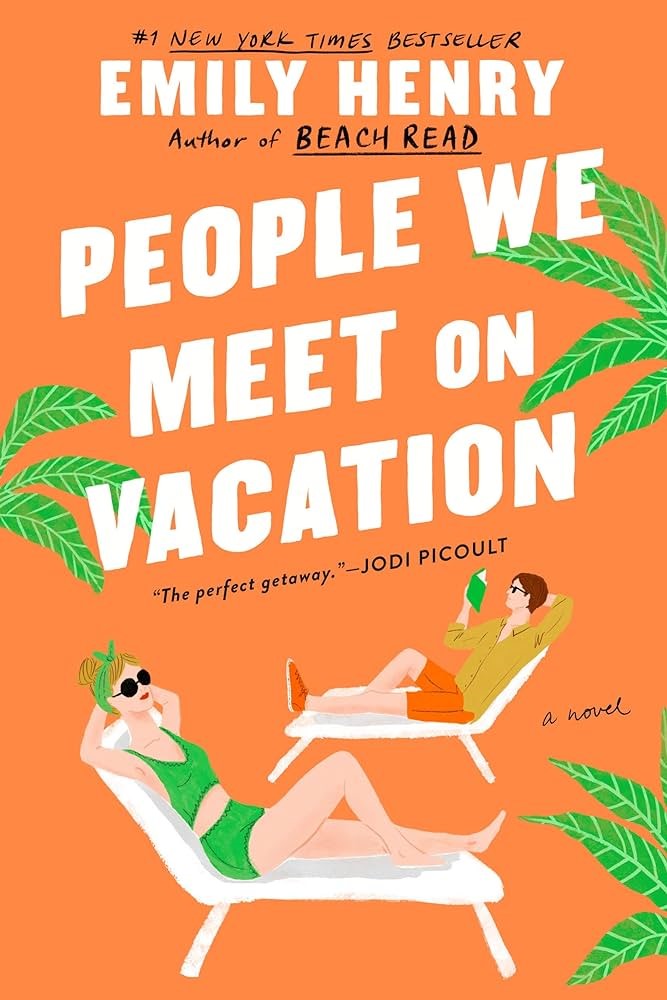
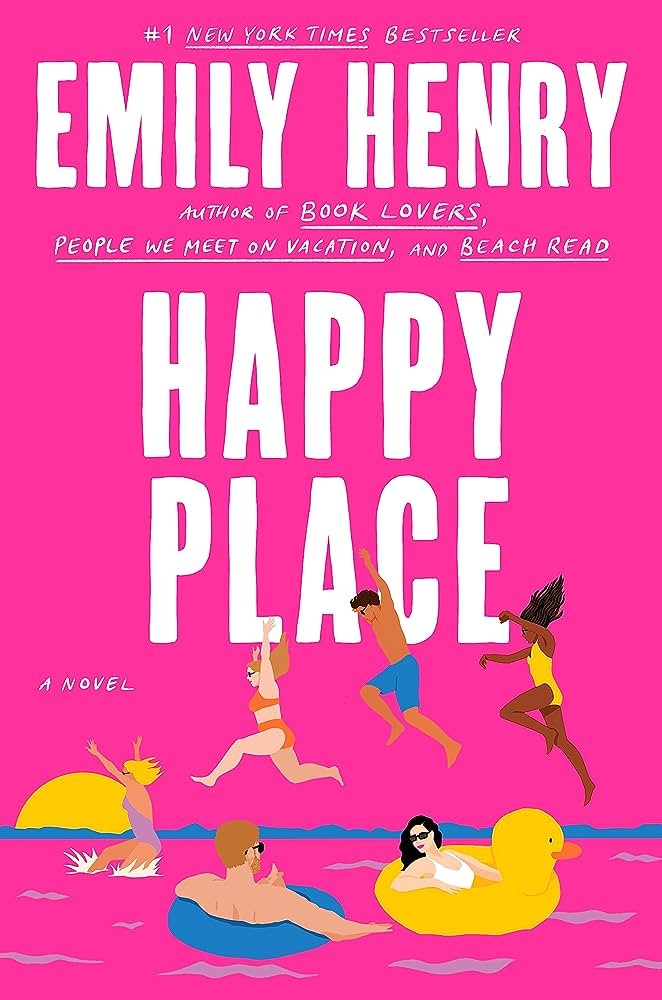
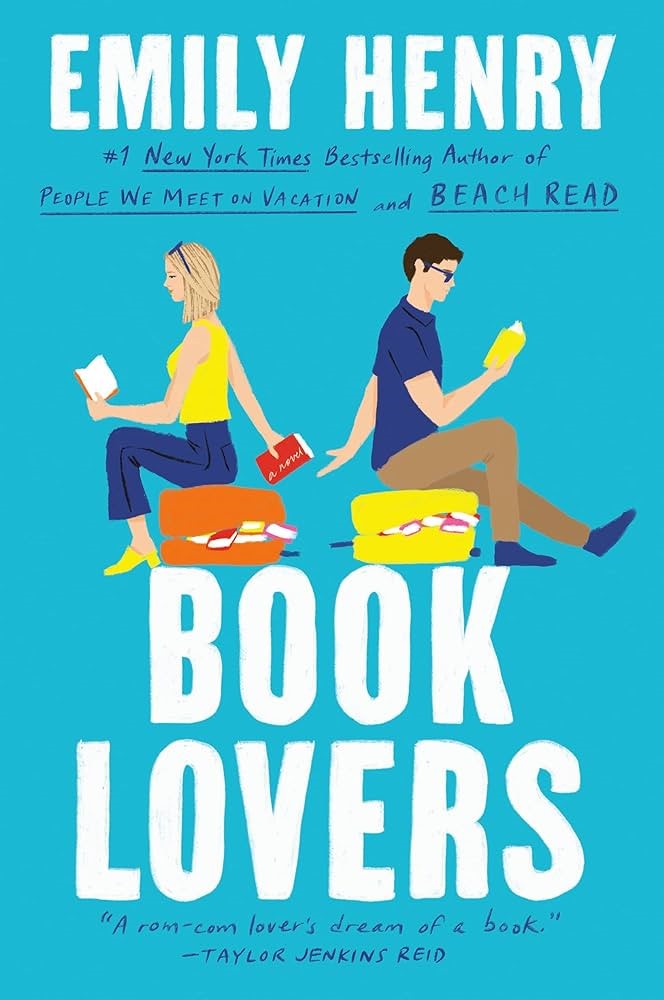
When one looks at Henry’s four books, the bold font and bright colors immediately stand out. Each book’s title and the name of the author is written in the same capitalized, bold white font, which helps with branding across all of Henry’s titles. From her first book, Beach Read, to her most recent book, Happy Place, Henry’s name became larger in font size, highlighting her fame and name recognition. Based on the bold font alone, it is clear that Henry’s covers are designed in a similar way so readers can easily identify the author’s work. Each cover also mentions Henry’s prior work and her bestseller label to show her popularity.
As for the specific designs, Henry’s covers are clearly intended to paint a vacation getaway, which adds to the escapism. Beach Read has a yellow background to signify a beach, and both characters are laying on towels. Both of the characters’ faces are hidden thanks to their positioning and accessories. The lack of faces on the cover helps readers imagine themselves as the main characters. One would also be unable to tell what this book is about based on the cover. The two characters are on their own separate beach towels, not interacting or looking at each other. Even though this book contains adult themes and a romantic storyline with sex scenes, one would not know that detail from looking at the cover; instead, they see a relaxing beach where one can escape to.
Henry’s second cover, People We Meet on Vacation, is bright orange with green leaves, painting a tropical getaway similar to Beach Read. The two main characters are relaxing on lounge chairs and wearing sunglasses, which hides some of their face and allows readers to place themselves in the characters’ shoes. These characters are also separate and not looking at each other, removing any romantic assumptions about the book.
Book Lovers’ cover is a bright teal and features the two main characters sitting back-to-back on suitcases and exchanging books. This detail references their careers as literary agents and publishers, but does not hint at their initial dislike of one another since they are sharing the books and sitting close to one another. The two characters are in profile, and the man is wearing glasses, so readers can instead imagine themselves as the main characters. While this cover features small details that hint at a vacation and the characters’ careers, it hides the adult themes and sexual content present in the book.
Happy Place’s cover is a bright pink and features six characters instead of the typical four. In the foreground, a man and woman in inflatable inner tubers float near each other. The man holds his hand out to the woman, showing their possible connection. The man’s back is to the reader, and the woman is wearing sunglasses, hiding her face. These details allow readers to imagine themselves as the main characters. In the foreground, four people are jumping into the water, which creates a relaxing ocean getaway. While the cover displays a vacation with a group of friends and hints at a possible relationship between the two characters in the foreground, the illustration does not show the adult themes or sexual content present in the book.
Henry’s cover designs, including both the font and illustrations, are uniform to help show the connection between her four titles. However, this uniformity was affected when Happy Place was released in hardback instead of paperback. Some fans responded negatively to this announcement on Henry’s Instagram post. Instagram user @maryaleem said, “bestie can we PLEASE get these in paperback, they need to match in my shelf” and Instagram user @alisatreadwell23 said, “I love this! But I need it in paperback” (emilyhenrywrites). These fan responses show how important uniformity is to readers. The covers share similarities, and owning all four books in paperback would be aesthetically pleasing on a person’s bookshelf. However, the hardback book is taller and sturdier than her paperback books. Despite her similar cover designs, this switch from paperback to hardback led Happy Place to look slightly different compared to her other books.
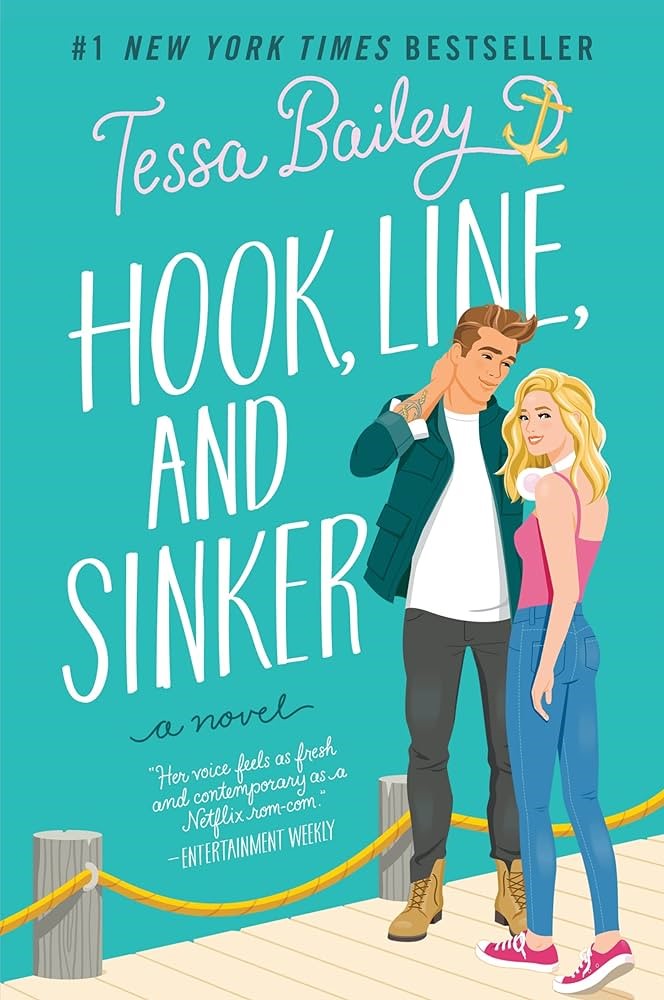
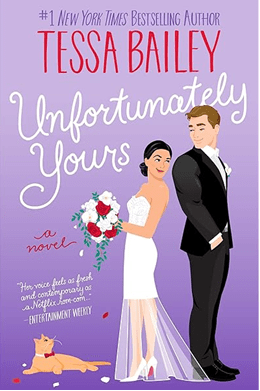
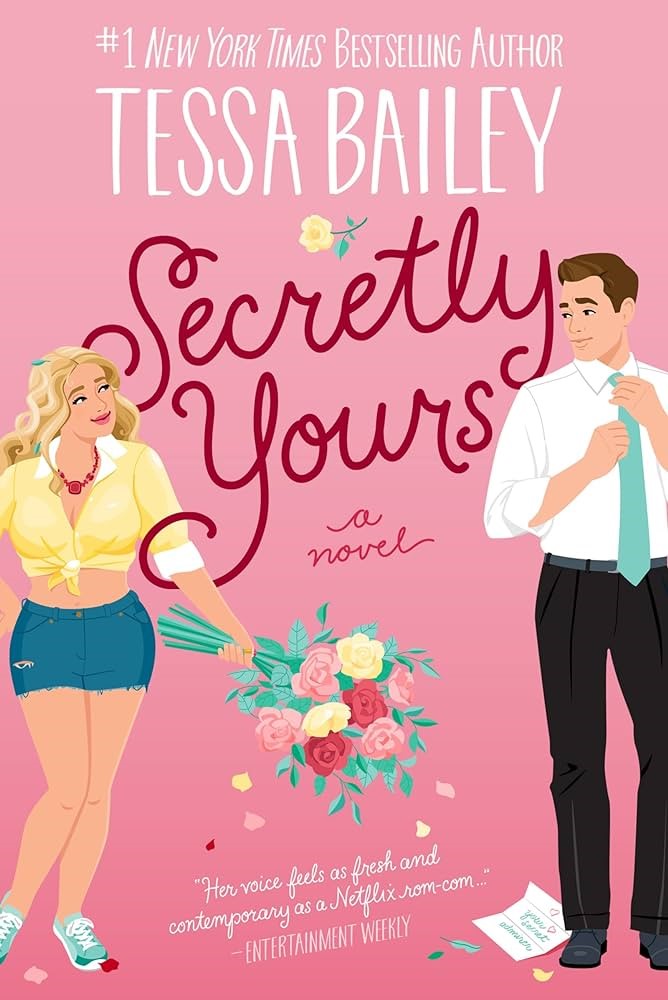
Bailey’s four book covers also display a type of uniformity thanks to the font and cover design, but Roe specifically designs the covers with the duology format in mind. It Happened One Summer and Hook, Line, and Sinker take places in the same coastal town and follow a pair of sisters meeting their partners and falling in love. Secretly Yours and Unfortunately Yours take place in the same New England town and follow a brother and sister meeting their partners and falling in love. Roe said she “make[s] the covers look similar by using the same scale of characters and style of lettering. Sometimes the lettering of the title may differ in a duology…but the poses of the characters…plus the lettering of [Bailey’s] name and the ‘#1 New York Times Bestselling Author” [line] is the same and tie everything together” (“New contact form message for Monika Roe Illustration via Contact”). All four covers utilize two different fonts – the capitalized letters and the cursive – but switch between using them for the title and using them for Bailey’s name. Each duology also has similar details that highlight connections between the two books. It Happened One Summer and Hook, Line, and Sinker have nautical details like waves, a lighthouse, an anchor, and a deck, while Secretly Yours and Unfortunately Yours both have the female characters holding bouquets.
It Happened One Summer is a dark navy blue. The two main characters frame the title, but are looking at each other. Unlike Henry’s covers, Bailey’s covers feature the characters interacting due to their positioning and eye contact. The male main character is crossing his arms, implying a grouchy and closed-off personality, and the female main character is wearing a nice dress and heels and placing her hand on her hip, implying a privileged and sassy personality. Based on the characters’ body language and clothing, readers can see that the two are opposites, but may have a connection based on their eye contact.
Hook, Line, and Sinker is a light teal. The main characters are standing close to one another, showing either their platonic or romantic relationship. While this cover hints at a connection between the two characters because of their closeness, the illustration does not possess any sexual implications. Both covers in this duology successfully hide the adult themes and sexual content, similar to Henry’s covers.
Secretly Yours is a light pink, which immediately creates a romantic atmosphere for the reader. The two characters frame the title of the book. The woman is holding a bouquet of flowers, hinting at her career as a gardener. The love letter at the man’s feet points to the novel’s main plot point: the female main character is sending secret admirer letters to the male main character. Readers can see some details of the plot from the cover alone. Similar to Bailey’s other covers, the two characters are looking at each other, implying a possible romantic connection.
The second book in the duology, Unfortunately Yours, is a light purple. The two characters are dressed in wedding attire, implying that they get married throughout the course of the novel. The two characters are standing back-to-back and smirking at one another. The smirks hint at a possible rocky relationship, which juxtaposes the wedding attire. Although the details connect to some plot elements, the two opposing details are meant to intrigue the readers and have them wonder why two characters who do not like each other are getting married. Similar to the first duology, the covers in this duology also hide the adult themes and sexual content present in these books.
Close-reading the eight romance covers, paired with secondary sources and information from Roe, led me to determine three reasons as to why the illustrated, cartoon covers are so popular within the contemporary romance genre: modesty, aesthetic, and escapism.
Conclusion
Although the romance genre has always been popular with readers, it is currently seeing an uptick in popularity thanks to younger readers promoting the books on social media apps like TikTok. Part of the genre’s popularity revolves around the illustrated, cartoon cover designs, which not only hide the books’ adult themes and sexual nature, but are also aesthetically pleasing and allow readers to escape into a fictional world and imagine themselves as the main characters.
Henry and Bailey’s covers achieve these aforementioned goals. The characters on Henry’s covers are often separate, and when they do interact, the body language is platonic in nature. These covers do not imply that the book is a romance, which helps remove the negative stigma surrounding the romance genre. Because the cover hides plot details from outside observers, readers may feel more comfortable reading the book in public. Bailey’s books also accomplish this modesty goal, even if the characters are positioned closer together and looking at each other. The body language and eye contact hints at a romantic relationship but does not possess a sexual context, so readers would feel more comfortable carrying and reading one of Bailey’s books in public. Thanks to the illustrated, cartoon covers, outside observers cannot tell what the book is about, which removes some of the negative stigma around the romance genre and makes readers more comfortable.
These illustrated, cartoon covers are also more aesthetically pleasing than the covers with real people or simple designs. According to Roe, “I have had comments from my fans that they love having such brightly colored covers on their book shelves. They see them [as] mini art pieces to be displayed together. They show them off cover facing out, not spine out” (“New contact form message for Monika Roe Illustration via Contact”). Each of Henry and Bailey’s covers are bright with specific art styles and characters. Based on the fan reactions to Henry’s paperback to hardback switch, it is clear that readers enjoy the covers’ uniformity for aesthetic and display purposes; the books look better on their bookshelves when they are the same height and size. The bright colors and illustrations are more aesthetically pleasing, leading more readers to pick up these books for both reading and display purposes.
Henry’s book covers also help with the escapist quality of the romance genre. Because the characters’ faces are usually hidden, readers can imagine themselves as the main characters. When Roe first started designing covers twenty years ago, “publishers didn’t want faces shown on the covers. This was so readers could imagine themselves as the main character of the book” (Roe). Henry’s characters’ faces are hidden on the covers, making it easier for readers to place themselves in their shoes. Even though Bailey’s books feature detailed and visible faces, the cartoon illustrations still connect to the genre’s escapism. The illustrations help create the fictional world of the novel, whereas real people would imply that the events of the novel are also real. Readers can easily escape into the fictional world because they do not associate the characters with real people – only themselves. If the characters on the covers are not real, the story is not real either, guaranteeing that readers can leave their “real world” with the help of a romantic, fictional book.
While this research process led me to identify three possible reasons for this cover style’s popularity, there are some missing gaps in my research. For example, some of the secondary sources were outdated. Fisher and Meredith implied that covers with real people are popular, while it is clear that cartoon illustrations are more popular now. Additionally, while Roe responded to my email interview request, Chiu never responded to my multiple emails. Her blog is sparse in terms of her creative process, so an interview would have provided more information on Henry’s covers and their uniformity.
The romance genre is ripe with plenty of potential research topics. Future researchers could consider how authors market their books within the romance genre, or close-read covers from different genres. They could even look at more contemporary romance authors and their covers to see if there are any outliers. Another potential topic that could stem from this research is diversity within the romance genre. Almost all of the characters on Henry and Bailey’s covers are white, and both authors are white. This line of research would also be interesting to see if the romance genre is increasing in diversity, or if marginalized authors are overlooked. This topic could connect to social media and which books become popular on TikTok and which do not. While some of the aforementioned secondary sources highlight an interest in the romance genre and its evolution, the genre is still overlooked in the academic field, despite its ever-growing popularity.
Works Cited
“About the Best Sellers.” https://www.nytimes.com/books/best-sellers/methodology/.
Bailey, Tessa. Hook, Line, and Sinker. HarperCollins, 2022.
—. It Happened One Summer. HarperCollins, 2021.
—. Secretly Yours. HarperCollins, 2023.
—. Unfortunately Yours. HarperCollins, 2023.
Cameron, Lauren. “The Romance Publishing Industry and Its Reputation.” Publishing Research Quarterly, vol. 36, 2020, pp. 1-16. https://doi.org/10.1007/s12109-019-09703-2.
Curcic, Dimitrije. “Romance Novel Sales Statistics.” Wordsrated, 9 October 2022, https://wordsrated.com/romance-novel-sales-statistics/.
McDavis-Conway, Shana. “Self-conscious, unapologetic, and straight: fat protagonists in romantic fiction.” Fat Studies, vol. 12, no. 2, 2023, pp. 233-242. https://doi.org/10.1080/21604851.2022.2047337
“Emily Henry.” https://www.emilyhenrybooks.com/.
Fisher, Maryanne L. and Meredith, Tami M. “The Success Behind the Candy-Colored Covers:
An Evolutionary Perspective on Romance Novels.” 2012, pp. 154-167.
Henry, Emily. Beach Read. Berkley, 2020.
—. Book Lovers. Berkley, 2022.
—. (emilyhenrywrites). “Enhanced for one.” Instagram, 10 August 2022, https://www.instagram.com/p/ChFahR0rSgh//.
—. Happy Place. Berkley, 2023.
—. People We Meet On Vacation. Berkley, 2021.
“Monika Roe Illustration.” https://monikaroe.com/.
Roe, Monika. “New contact form message for Monika Roe Illustration via Contact.” 15 November 2023.
“Sandra Chiu.” https://www.sandrachiu.com/.
Schwartz, Deanna and Sullivan, Meghan Collins. “Gen Z is driving sales of romance books to the top of bestseller lists.” NPR, 29 August 2022, https://www.npr.org/2022/08/29/1119886246/gen-z-is-driving-sales-of-romance-books-to-the-top-of-bestseller-lists.
“Stats.” The Storygraph, https://app.thestorygraph.com/.
Temple, Emily. “These are the bestselling books of 2022.” Literary Hub, 14 January 2023,
“Tessa Bailey.” https://www.tessabailey.com/.
Appendix

 Washington College Review
2 Comments Add yours