
By Elizabeth Fitzpatrick ’26
Major: Art History; Minors: French Studies and Museum, Field, & Community Education
Contributor Biography: Elizabeth Fitzpatrick is an art history major from Catonsville, MD. In the future, she hopes to work in a museum to share her love of art with others. In her free time, she enjoys reading, making art, and watching really bad movies.
Brief Description: This essay looks at the historical ties of museum institutions to colonialism. It explores possible answers to the question of how museums can address colonial legacies, such as repatriation and collaboration with marginalized communities, as well as how contemporary artists are using historical images to engage with the legacy of colonization.
The following was written for ART 294: Latin American and Caribbean Art History
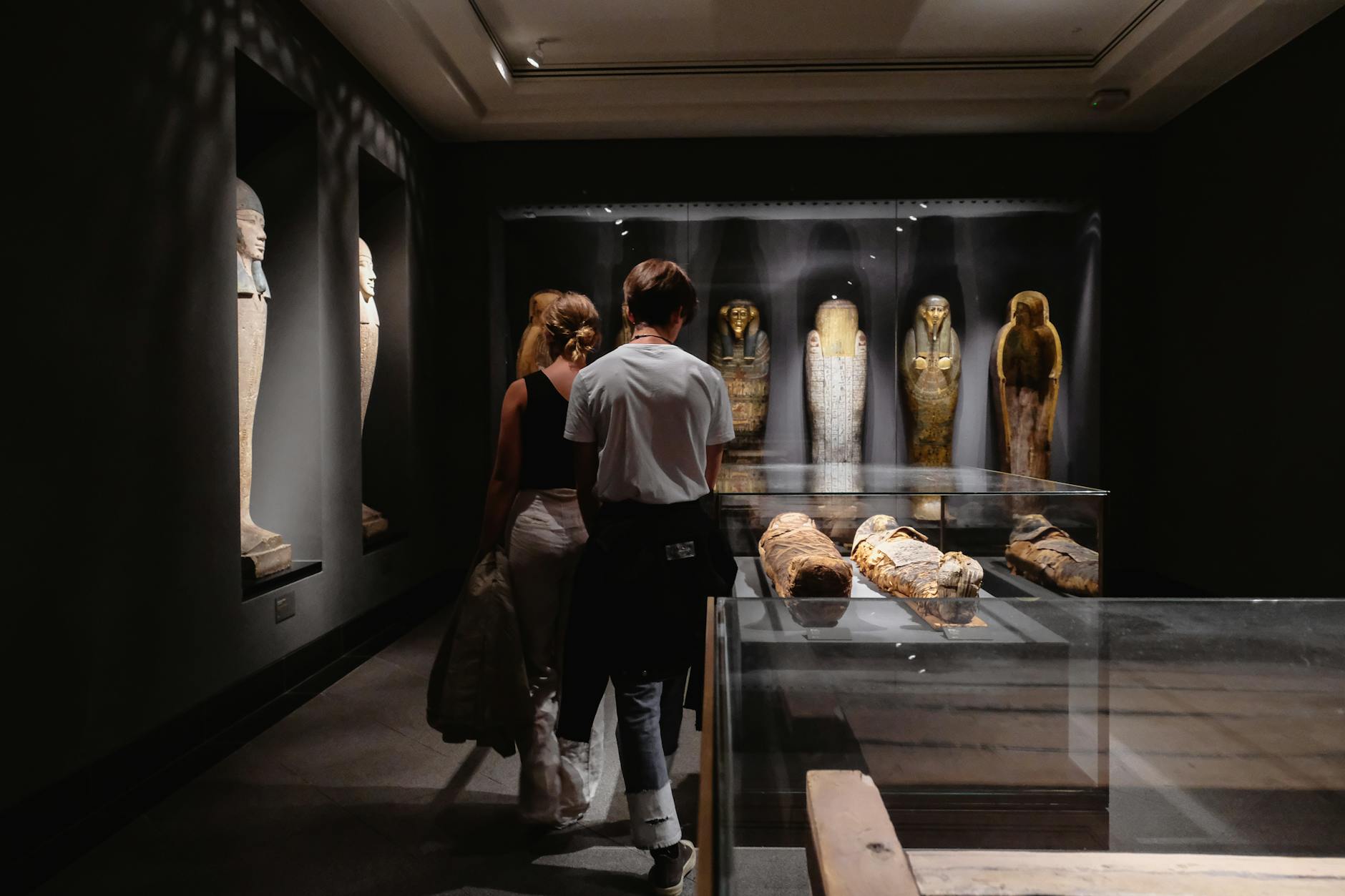
Whenever you visit a museum, you may notice artworks, objects, and artefacts from many different cultures. As museums try to adapt their practices to the modern world, there is an increasing call for museums to examine their collections and their ties to the legacy of colonialism. Many objects in museums in Europe and North America have a dubious record of ownership involving theft and colonization. Notably, the British Museum has been criticized for denying repatriation requests.[1] The question of how to proceed is difficult to answer. Should objects be returned to their original owners or cultures? What if the original owner is untraceable or no longer exists? As infamous fictional archaeologist Indiana Jones says, “it belongs in a museum”—but how much is the public entitled to these objects in the name of anthropological education?[2] If museums do retain these objects in their collections, how can they be most respectfully displayed? In this essay, I seek to explore the potential answers to these questions.
Historically, the ethnographic or anthropological museum—distinct from the art museum—has been a place for the display of objects of anthropological value. The area of art history primarily focuses on European art, leaving non-European art to the ethnographic museum.[3] In their essay “The future of the ethnographic museum,” Clare Harris and Michael O’Hanlon write that objects stood in “for the distant ‘others’ and distant places” studied by anthropologists, which dines agency to the subject.[4] This practice exoticizes non-European art, distinctly separating it from the art considered worthy of study. European art is art. Non-European art is ethnographic object.
One example of the clear distinction created between the areas of art history and anthropology is in the case of a series of nineteenth century portraits of Haitian revolutionary and presidential leaders. In 1963, the portraits were found in the Smithsonian’s collection storage, where they had been placed after being marked “of no artistic merit.”[5] Despite their significance to both the development of Haitian art and the depiction of Haitian history, the portraits were viewed only through a lens that compared them unfavorably to European artworks. Erica Moiah James notes that “Not a single thing about these remarkably similar portraits changed over the course of time, except for the disciplinary lens through which they are viewed and (de)valued.”[6] James argues that Haitian artwork—and, by extension, other Non-European artwork—should be understood as having artistic value of its own. To fully see this value, we must divorce our understanding of “good art” from Western understandings of artistic development.[7]
Colonialism and anthropology are inherently linked, but efforts are being made to address colonial legacies in the field and incorporate post-colonial study into museum practices. Museum curator Nanette Snoep described the difference between her experiences in museums in Germany and France. She found the French environment was more open to the blurring of distinctions, while in Germany she found herself up against more rigid barriers that she felt limited her curation.[8] Although there is a general trend towards decolonization, it is difficult to make any sweeping statements because considering the collections, structures, and cultural environments of each individual museum is essential to this work. Anthropologist and museum director Wayne Modest says that, despite his belief that anthropology and the museum can never be fully separated from their colonial history, he continues to believe in the importance of anthropology as a discipline. He claims that anthropology serves as a reminder that we are not the center of the world, destabilizing our preconceptions of other cultures.[9]
So, how can museums begin the process of decolonization? Repatriation is one method that is frequently called for. As mentioned earlier, the British Museum has received numerous requests for repatriation—most infamously for the return of the Parthenon Marbles to the Acropolis Museum in Greece—but many other formal requests have been made, such as a request from Nigeria to return a collection of 900 items.[10] However, focusing solely on repatriation can become complicated.
One such example is a collection of three cemí that reside in the collection of the British Museum. Carved wooden cemí were used in the religious practices of the Taíno people who once inhabited the island now known as Jamaica. Art historian Rachel Grace Newman argues that cemí should not be understood as artworks or artifacts, but as animate forces, which is closer to the way they were conceptualized and used in the religious practices of the Taíno.[11] Once again, Western conceptions of art and object have been falsely applied to non-Western cultures. Central to our topic, however, is Newman’s discussion of what should happen to the cemí.
In 1994, the British Museum denied a request from the National Gallery of Jamaica to borrow the cemí. One could argue that the cemí should be returned to Jamaica, but the very concept of Jamaica is also a colonial construction, still impacted by the legacy of British colonization. Does the country of Jamaica really have any more claim than the museum to ownership of the cemí, forces that by their very nature cannot be owned by anyone? Although the Taíno still remain on the island, their culture and people were decimated by the European enslavement. The Taíno culture and religion does not exist as it once did, and cannot ever return due to the lasting cultural genocide of colonization.[12] Perhaps the cemí can be returned to their place of origin, and perhaps that will help relieve some of the pain, but it cannot undo what has already been done. For many cases, finding a solution is not as simple as sending the objects “home.”
As previously discussed, the separation of art pieces into distinct categories of “art history” and “anthropology” exoticizes and diminishes the artistic achievements of non-Western cultures. Several museums have course corrected by prominently featuring contemporary artists to draw connections with historical pieces.[13] This work highlights the achievements of artists from historically marginalized communities. However, this practice has been criticized as surface-level improvement that does little to address systemic issues. Prioritizing “recognition” and “inclusion” does little to challenge the legacy of colonial power structures; it simply broadens definitions only if Indigenous artwork conforms to Western views.[14] Kathleen Ash-Milby and Ruth B. Phillips write about the need to prioritize autonomy in historically marginalized communities and allow these communities creative control over their own story by centering them at all levels of the field, not just in the objects on display.
For example, they describe an exhibition of beaded moccasins designed by Indigenous curator Gerald McMaster. He arranged the moccasins in a spiral to imitate dancing feet.[15] The moccasins are the type of artwork or object that would typically be displayed using anthropological language of curation, which uses rigid mountings and separate display cases.[16] Instead, McMaster turned the display into a work of art itself. Ash-Milby and Phillips describe this process as “meld[ing] the practice of the contemporary art installation with the function of historic artifact display, jettisoning the standard grids of the Western museum.”[17] By promoting Indigenous voices behind the scenes, the exhibition beautifully highlighted the real-life use of the moccasins, rather than divorcing them from context.
Curator Nanette Snoep describes the way that, unfortunately, a desire to decolonize anthropological museums often results in the museums leaving the heavy lifting to artists. She believes curatorial work should be a collaborative process with the artist, much like how Wayne Modest believes that anthropologists should always be listening to critique.[18] The process may be difficult and uncomfortable, but it is necessary and cannot be pushed off onto others. Snoep wants the museum to be a bridge between history and contemporary artists, “a repository for…artistic production.”[19] Many contemporary artists, such as Jackie Milad, Malcolm Bailey, and María Magdalena Campos-Pons, are using historical artworks as jumping-off points for conversations about historical legacies.
Jackie Milad is a Baltimore-based artist who incorporates her own experiences as a child of immigrants into her artwork, using her parents’ Honduran and Egyptian culture as inspiration for many of her pieces. She describes her process as thinking about the layers of history both on an individual and global scale and how they relate to her chosen medium of collage as something that builds up over time.[20] Her recent exhibition, “Undoing the Knotted Parts,” deals with the history of British scholars unwrapping mummies for large audiences, as well as the way Egyptian figurines have been removed from their original context and taken on a new meaning as they have spread around the world.[21]
Malcolm Bailey and María Magdalena Campos-Pons are two artists who have incorporated imagery associated with slavery and the Atlantic Slave Trade into their artwork. Campos-Pons works in a variety of mediums and incorporates her experience as a Cuban woman with roots in West African Yoruba culture into her work. Her artworks frequently use imagery of water and boats, evoking the history of displacement and migration, but also resiliency and rebirth.[22] Malcolm Bailey is noted for his use of the icon of the slave ship, derived from eighteenth century diagrams. He incorporated this imagery into works such as Hold, Separate but Equal (1969) in order to comment on contemporary civil rights issues. He links modern forms of oppression to the legacy of slavery by putting the historical image of violence in conversation with events that came after it and because of it.[23]
Wayne Modest encounters many people who want to believe that colonization is over and has no further impact.[24] All of these artists, who are creating art in conversation with the legacy of colonization and enslavement, are doing important work to demonstrate the ongoing impacts of colonization. The museum creates a space for history to be displayed in conjunction with the modern, to blur boundaries of time by engaging with the past through contemporary art.
There is no easy answer to any question about the ties between museums and the legacy of violence and oppression left by colonialism. Many of the objects found in museum collections must be displayed in collaboration with the historically marginalized communities these objects represent. Methods must be reconsidered, and the lasting impact of colonial violence cannot be overlooked just because it is difficult to examine. Museums are not neutral spaces isolated from the larger world; the goal of the museum must always be to listen and respond to the audience and to remind visitors that even though they are viewing objects from the past, those objects have lasting connections.
Bibliography
Ash-Milby, Kathleen, and Ruth B. Phillips. “Inclusivity or Sovereignty? Native American Arts in the Gallery and the Museum Since 1992.” In Art Journal 76, no. 2 (2017): 10-38. https://www.jstor.org/stable/45142470.
Frist Art Museum. “María Magdalena Campos-Pons: Behold.” Accessed December 8, 2024. https://fristartmuseum.org/exhibition/maria-magdalena-campos-pons/.
Harris, Clare, and Michael O’Hanlon. “The future of the ethnographic museum.” In Anthropology Today 29, no. 1 (2013): 8-12, https://www.jstor.org/stable/23486436.
James, Erica Moiah “Decolonizing Time: Nineteenth-Century Haitian Portraiture and the Critique of Anachronism in Caribbean Art.” In Nka: Journal of Contemporary African Art, no. 44 (2019): 8-23 https://muse.jhu.edu/article/727268.
Milad, Jackie. “Summer 2021 artist-in-residence Jackie Milad.” Posted September 16, 2021, by McColl Center, YouTube, 2 min., 14 sec., https://www.youtube.com/watch?v=6gRdlcxlxpQ.
Milad, Jackie. “Undoing the Knotted Parts.” Jackie Milad. Accessed December 8, 2024. https://jackiemilad.com/section/529047-Undoing%20the%20Knotted%20Parts.html.
Modest, Wayne. “’Museums are Investments in Critical Discomfort.’” In Across Anthropology: Troubling Colonial Legacies, Museums, and the Curatorial, edited by Margareta von Oswald and Jonas Tinius. Leuven University Press, 2020, 65–75. https://doi.org/10.2307/j.ctv125jqxp.8.
MoMA. “Hold, Separate but Equal.” Accessed December 8, 2024. https://www.moma.org/collection/works/79590?artist_id=287&page=1&sov_referrer=artist.
Newman, Rachel Grace. “The Cemí and the Museum.” In American Art 3, no. 2 (2022): 13-19, https://doi.org/10.1086/720911.
Snoep, Nanette. “‘Suggestions for a Post-Museum.’” In Across Anthropology: Troubling Colonial Legacies, Museums, and the Curatorial, edited by Margareta von Oswald and Jonas Tinius. Leuven University Press, 2020, 324–35. https://www.jstor.org/stable/j.ctv125jqxp.22.
Spielberg, Steven, director. Indiana Jones and the Last Crusade. Paramount Pictures, 1989. 2 hr., 13 min. https://www.amazon.com/gp/video/detail/0TMBVDS3ESQCT23T3IG9CW0QJR/ref=atv_plr_detail_play.
Tremayne-Pengelly, Alexandra. “The UK Has a 60-Year Old Law Prohibiting Repatriation of Art. Is That About to Change?” Observer, February 11, 2023. https://observer.com/2023/02/the-uk-has-a-60-year-old-law-prohibiting-repatriation-of-art-is-that-about-to-change/.
[1] Alexandra Tremayne-Pengelly, “The UK Has a 60-Year Old Law Prohibiting Repatriation of Art. Is That About to Change?,” Observer, February 11, 2023, https://observer.com/2023/02/the-uk-has-a-60-year-old-law-prohibiting-repatriation-of-art-is-that-about-to-change/.
[2] Indiana Jones and the Last Crusade, directed by Steven Spielberg (Paramount Pictures, 1989), 0:12:28, https://www.amazon.com/gp/video/detail/0TMBVDS3ESQCT23T3IG9CW0QJR/ref=atv_plr_detail_play.
[3] Wayne Modest, “’Museums are Investments in Critical Discomfort,’” in Across Anthropology: Troubling Colonial Legacies, Museums, and the Curatorial, ed. Margareta von Oswald and Jonas Tinius (Leuven University Press, 2020), 73, https://doi.org/10.2307/j.ctv125jqxp.8.
[4] Clare Harris and Michael O’Hanlon. “The future of the ethnographic museum,” in Anthropology Today 29, no. 1 (2013): 8, https://www.jstor.org/stable/23486436.
[5] Ericah Moiah James, “Decolonizing Time: Nineteenth-Century Haitian Portraiture and the Critique of Anachronism in Caribbean Art,” in Nka: Journal of Contemporary African Art, no. 44 (2019): 16-17, https://muse.jhu.edu/article/727268.
[6] James, “Decolonizing Time,” 17.
[7] James, “Decolonizing Time,” 10.
[8] Nanette Snoep, “’Suggestions for a Post-Museum,’” in Across Anthropology: Troubling Colonial Legacies, Museums, and the Curatorial, ed. Margareta von Oswald and Jonas Tinius, (Leuven University Press, 2020), 329, https://www.jstor.org/stable/j.ctv125jqxp.22.
[9] Wayne Modest, “’Museums are Investments in Critical Discomfort,’” in Across Anthropology: Troubling Colonial Legacies, Museums, and the Curatorial, ed. Margareta von Oswald and Jonas Tinius (Leuven University Press, 2020), 66, https://doi.org/10.2307/j.ctv125jqxp.8.
[10] Tremayne-Pengelly, “The UK Has a 60-Year Old Law.”
[11] Rachel Grace Newman, “The Cemí and the Museum,” in American Art 3, no. 2 (2022): 13, https://doi.org/10.1086/720911.
[12] Newman, “The Cemí and the Museum,” 13-18.
[13] Harris and O’Hanlon, “The future of the ethnographic museum,” 10.
[14]Kathleen Ash-Milby and Ruth B. Phillips, “Inclusivity or Sovereignty? Native American Arts in the Gallery and the Museum Since 1992,” in Art Journal 76, no. 2 (2017): 12, https://www.jstor.org/stable/45142470.
[15] Ash-Milby and Phillips, “Inclusivity or Sovereignty?,” 17.
[16] Snoep, “’Suggestions for a Post-Museum,’” 331-332.
[17] Ash-Milby and Phillips, “Inclusivity or Sovereignty?,” 17.
[18] Snoep, “’Suggestions for a Post-Museum,’” 332; Modest, “’Museums are Investments in Critical Discomfort,’” 69.
[19] Snoep, “’Suggestions for a Post-Museum,’” 333.
[20] Jackie Milad, “Summer 2021 artist-in-residence Jackie Milad,” posted September 16, 2021, by McColl Center, YouTube, 2 min., 14 sec., https://www.youtube.com/watch?v=6gRdlcxlxpQ.
[21] “Undoing the Knotted Parts,” Jackie Milad, accessed December 8, 2024, https://jackiemilad.com/section/529047-Undoing%20the%20Knotted%20Parts.html.
[22] “María Magdalena Campos-Pons: Behold,” Frist Art Museum, accessed December 8, 2024. https://fristartmuseum.org/exhibition/maria-magdalena-campos-pons/.
[23] “Hold, Separate but Equal.” MoMA, accessed December 8, 2024. https://www.moma.org/collection/works/79590?artist_id=287&page=1&sov_referrer=artist.
[24] Modest, “’Museums are Investments in Critical Discomfort,’” 67.
 Washington College Review